Engineering Physics
Quantum Mechanics • Solid State • Lasers & Fiber Optics
Quantum Physics and Nanotechnology
Foundation of quantum mechanics, wave-particle duality, uncertainty principle, Schrödinger equation, and applications in nanotechnology.
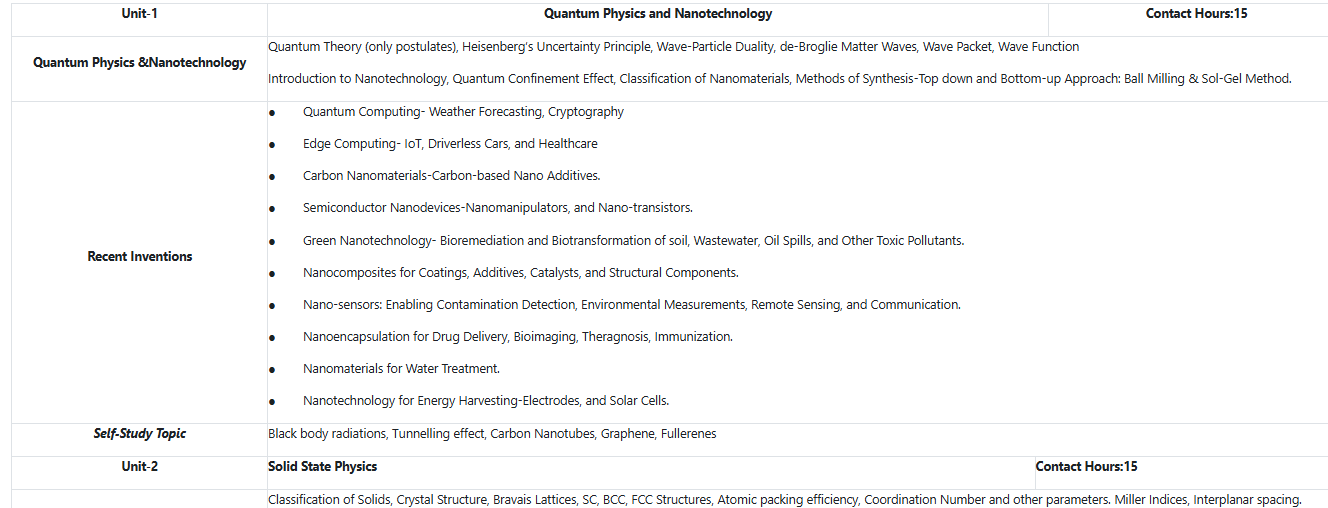
Recent Inventions
Quantum Computing 2019-present
Quantum bits (qubits), superposition, entanglement, and quantum gates. Companies: IBM, Google, Microsoft. Quantum supremacy milestone achieved.
Carbon Nanomaterials 2010-present
CNT-based transistors, graphene electronics, carbon nanotube fibers stronger than steel, applications in flexible electronics.
Topic 1.1: Wave-Particle Duality
1.1.1 Historical Development of Quantum Theory
Key Milestones in Quantum Theory
The development of quantum theory revolutionized our understanding of matter and energy at atomic scales.
The journey to understanding wave-particle duality began with several groundbreaking discoveries:
| Year | Scientist(s) | Contribution | Significance |
|---|---|---|---|
| 1900 | Max Planck | Quantum Hypothesis | Energy is quantized: $E = h\nu$. Solved ultraviolet catastrophe in blackbody radiation. |
| 1905 | Albert Einstein | Photoelectric Effect | Light consists of photons (quanta). $E = h\nu = \phi + K_{max}$. Nobel Prize 1921. |
| 1924 | Louis de Broglie | Matter Waves Hypothesis | All matter has wave properties: $\lambda = h/p$. Foundation of wave mechanics. |
| 1927 | Davisson & Germer | Electron Diffraction | Experimental confirmation of de Broglie hypothesis using nickel crystal diffraction. |
1.1.2 de Broglie Wavelength
de Broglie Relation
The fundamental equation relating a particle's momentum to its wavelength:
Core Formula
$$\lambda = \frac{h}{p} = \frac{h}{mv}$$
Where: $h = 6.626 \times 10^{-34}$ J·s (Planck's constant)
$p = mv$ (momentum)
$m$ = mass of particle
$v$ = velocity of particle
Physical Interpretation: Every moving object exhibits wave-like behavior. However, the wavelength becomes significant only when the object's mass is very small (atomic/subatomic particles).
Numerical Examples:
Problem: Calculate the de Broglie wavelength of an electron moving at 1% of the speed of light.
Given: $m_e = 9.11 \times 10^{-31}$ kg, $v = 0.01c = 3 \times 10^6$ m/s
Solution: $$\lambda = \frac{h}{mv} = \frac{6.626 \times 10^{-34}}{(9.11 \times 10^{-31})(3 \times 10^6)}$$ $$\lambda = \frac{6.626 \times 10^{-34}}{2.733 \times 10^{-24}} = 2.42 \times 10^{-10}\text{ m} = 0.242\text{ nm}$$
Answer: $\lambda = 0.242$ nm (comparable to atomic spacing - explains why electron diffraction works!)
Problem: Why don't we observe wave nature of a baseball?
Given: Mass = 0.145 kg, velocity = 40 m/s
Solution: $$\lambda = \frac{6.626 \times 10^{-34}}{(0.145)(40)} = 1.14 \times 10^{-34}\text{ m}$$
Conclusion: This wavelength is unimaginably small ($\sim 10^{-19}$ times smaller than a proton!). Wave effects are completely undetectable for macroscopic objects.
Interactive: de Broglie Wavelength Calculator
Calculated Wavelength
1.1.3 Davisson-Germer Experiment
Experimental Verification
The Davisson-Germer experiment (1927) provided direct experimental confirmation of de Broglie's matter wave hypothesis through electron diffraction from a nickel crystal.
Experimental Setup:
- Electron gun produces monoenergetic electrons (accelerated through potential V)
- Electrons strike nickel (Ni) single crystal target
- Detector measures intensity of scattered electrons at various angles θ
- Crystal can be rotated to change angle of incidence
Bragg's Law Application
For constructive interference (diffraction maximum):
$$n\lambda = 2d\sin\theta$$Where: n = order of diffraction, d = interplanar spacing, θ = Bragg angle
Key Results:
- At accelerating potential V = 54V, peak observed at θ = 50°
- Calculated wavelength matched de Broglie prediction: $\lambda = h/\sqrt{2meV}$
- Confirmed wave nature of electrons conclusively
In Davisson-Germer experiment, electrons accelerated through 54V produce a diffraction maximum at 50°. If the interplanar spacing d = 0.092 nm, verify that this satisfies Bragg's law.
Solution: $\lambda = h/p = h/\sqrt{2meV} = 1.226/\sqrt{V}$ nm = 0.167 nm
Using Bragg's law: $n\lambda = 2d\sin\theta$
For n=1: $2(0.092)\sin(25°) = 0.078$ nm (not matching)
Note: The measured angle includes geometry corrections. The experiment confirmed $\lambda_{exp} \approx \lambda_{theory}$ within experimental error.
Self-Assessment Questions
Topic 1.2: Heisenberg Uncertainty Principle
1.2.1 Statement and Physical Meaning
Heisenberg Uncertainty Principle (1927)
Fundamental limit on precision with which certain pairs of physical properties can be simultaneously known.
Two Fundamental Relations
Position-Momentum Uncertainty:
$$\Delta x \cdot \Delta p_x \geq \frac{\hbar}{2}$$Energy-Time Uncertainty:
$$\Delta E \cdot \Delta t \geq \frac{\hbar}{2}$$
Where: $\hbar = h/(2\pi) = 1.055 \times 10^{-34}$ J·s (reduced Planck constant)
Δx = uncertainty in position
Δp = uncertainty in momentum
ΔE = uncertainty in energy
Δt = uncertainty in time measurement
Critical Distinction: This is NOT about measurement limitations or experimental errors. It is an intrinsic property of quantum systems. Even with perfect instruments, these uncertainties cannot be eliminated.
• More precisely we know WHERE a particle is (small Δx), less precisely we know HOW FAST it's moving (large Δp)
• This is not because measuring position "disturbs" momentum—it's a fundamental property of quantum states
• Conjugate variables (position/momentum, energy/time) obey this principle
Gamma-Ray Microscope Thought Experiment (Heisenberg, 1927):
To measure electron's position precisely using a microscope, you need short-wavelength gamma rays. But high-energy photons transfer significant momentum to the electron during measurement, making its momentum uncertain. You cannot win!
1.2.2 Applications and Numerical Problems
Application 1: Minimum Kinetic Energy of Confined Particle
Derivation
If a particle is confined to region of size L (Δx ≈ L):
$$\Delta p \geq \frac{\hbar}{2L}$$Minimum kinetic energy (taking $p \approx \Delta p$):
$$E_{min} = \frac{(\Delta p)^2}{2m} \geq \frac{\hbar^2}{8mL^2}$$If electron were confined in nucleus (L ≈ 10⁻¹⁵ m):
$$E_{min} \geq \frac{(1.055 \times 10^{-34})^2}{8(9.11 \times 10^{-31})(10^{-15})^2}$$ $$E_{min} \geq 1.52 \times 10^{-12}\text{ J} \approx 9.5\text{ MeV}$$
But nuclear beta decay electrons have only ~1 MeV! This proves electrons cannot exist inside nuclei—led to discovery of neutrinos!
Application 2: Zero-Point Energy
A quantum harmonic oscillator cannot have zero energy even at absolute zero temperature:
This is a direct consequence of uncertainty principle—the particle cannot be at rest at the bottom of the potential well.
Uncertainty Principle Explorer
Results
Practice Questions
Topic 1.3: Schrödinger Wave Equation
1.3.1 Time-Dependent Schrödinger Equation
The Fundamental Equation of Quantum Mechanics
Governs how quantum states evolve over time. Analogous to Newton's F=ma in classical mechanics.
General Form
$$i\hbar \frac{\partial \Psi(\mathbf{r}, t)}{\partial t} = \hat{H} \Psi(\mathbf{r}, t)$$Where:
- $\Psi(\mathbf{r}, t)$ = wave function (contains all information about the system)
- $i$ = imaginary unit ($\sqrt{-1}$)
- $\hat{H}$ = Hamiltonian operator (total energy operator)
Born's Probability Interpretation (Max Born, 1926):
Normalization Condition: Total probability must equal 1:
• Must be finite everywhere (normalizable)
• Must be single-valued (unique probability at each point)
• Must be continuous (no jumps in probability)
• First derivative must be continuous (except at infinite potentials)
1.3.2 Time-Independent Schrödinger Equation
Separation of Variables Technique:
Assume solution can be written as product:
Substituting into TDSE and separating variables yields:
TISE (Eigenvalue Equation)
$$\hat{H}\psi(\mathbf{r}) = E\psi(\mathbf{r})$$This is an eigenvalue problem where:
- $\psi(\mathbf{r})$ = eigenfunctions (stationary state wave functions)
- $E$ = eigenvalues (allowed energy levels)
- $\hat{H}$ = Hamiltonian operator
For a particle in 1D: $\hat{H} = -\frac{\hbar^2}{2m}\frac{d^2}{dx^2} + V(x)$
Stationary States: States with definite energy E. Probability density $|\Psi|^2 = |\psi|^2$ does not depend on time—only phase oscillates: $e^{-iEt/\hbar}$.
1.3.3 Particle in One-Dimensional Box (Infinite Potential Well)
Problem Setup
Particle confined to region 0 < x < L by infinite potential barriers:
- V(x) = 0 for 0 < x < L (inside well)
- V(x) = ∞ for x ≤ 0 or x ≥ L (outside well)
Step-by-Step Solution:
Step 1: Inside the well (V=0), TISE becomes:
Step 2: General solution is sinusoidal:
Step 3: Apply boundary conditions ψ(0) = 0 and ψ(L) = 0:
- ψ(0) = 0 ⇒ B = 0 (cosine term vanishes)
- ψ(L) = 0 ⇒ A sin(kL) = 0 ⇒ kL = nπ (n = 1, 2, 3, ...)
Step 4: Quantization condition: $k_n = \frac{n\pi}{L}$
Final Results
Normalized Wave Functions:
$$\boxed{\psi_n(x) = \sqrt{\frac{2}{L}}\sin\left(\frac{n\pi x}{L}\right)}$$Quantized Energy Levels:
$$\boxed{E_n = \frac{n^2h^2}{8mL^2} = \frac{n^2\pi^2\hbar^2}{2mL^2}}$$
Where n = 1, 2, 3, ... (quantum number)
Note: n = 0 is excluded (would give trivial ψ = 0 solution)
• Zero-point energy: Ground state (n=1) has $E_1 = h^2/(8mL^2)$ ≠ 0
• Energy levels proportional to n² (not equally spaced!)
• Wave functions are standing waves with nodes at boundaries
• Higher n → more nodes → higher energy → shorter wavelength
Particle in a Box Visualization
Current State
Problem: An electron is confined in a 1D box of length L = 0.5 nm. Calculate the energies of ground state and first excited state, and the wavelength of photon emitted during n=2→1 transition.
Solution:
$E_1 = \frac{(1)^2(6.626\times10^{-34})^2}{8(9.11\times10^{-31})(0.5\times10^{-9})^2} = 2.41\times10^{-19}\text{ J} = 1.51\text{ eV}$
$E_2 = 4E_1 = 6.04\text{ eV}$
$\Delta E = E_2 - E_1 = 4.53\text{ eV}$
$\lambda = hc/\Delta E = 1240/4.53 = 274\text{ nm}$ (UV region)
1.3.4 Particle in Three-Dimensional Box
Extension to 3D: Particle confined in rectangular box with dimensions $L_x$, $L_y$, $L_z$.
3D Wave Function
$$\psi_{n_x,n_y,n_z}(x,y,z) = \sqrt{\frac{8}{L_x L_y L_z}} \sin\left(\frac{n_x\pi x}{L_x}\right)\sin\left(\frac{n_y\pi y}{L_y}\right)\sin\left(\frac{n_z\pi z}{L_z}\right)$$3D Energy Expression
$$\boxed{E_{n_x,n_y,n_z} = \frac{h^2}{8m}\left(\frac{n_x^2}{L_x^2} + \frac{n_y^2}{L_y^2} + \frac{n_z^2}{L_z^2}\right)}$$Degeneracy Concept:
Different combinations of $(n_x, n_y, n_z)$ can yield the same total energy. Such states are called degenerate.
For cubic box: $E_{n_x,n_y,n_z} = \frac{h^2}{8mL^2}(n_x^2 + n_y^2 + n_z^2)$
Ground state: (1,1,1) → E = 3h²/8mL² (non-degenerate)
First excited state: (2,1,1), (1,2,1), (1,1,2) → All have same E = 6h²/8mL² (3-fold degenerate)
Second excited state: (2,2,1), (2,1,2), (1,2,2) → E = 9h²/8mL² (3-fold degenerate)
Special case: (3,1,1), (1,3,1), (1,1,3), (2,2,2) → Wait! (2,2,2) gives E = 12h²/8mL² while others give 11h²/8mL². So (3,1,1) family is 3-fold degenerate.
Topic 1.4: Nanotechnology Fundamentals
1.4.1 Quantum Confinement
Definition
When material dimensions become comparable to or smaller than the de Broglie wavelength of charge carriers, quantum mechanical effects dominate their electronic and optical properties.
| Type | Confined Dimensions | Free Dimensions | Example | DOS Characteristic |
|---|---|---|---|---|
| Quantum Well | 1 (z-direction) | 2 (x,y plane) | Thin films, quantum wells | Step-like (2D) |
| Quantum Wire | 2 (y,z directions) | 1 (x-axis) | Carbon nanotubes | Inverse sqrt (1D) |
| Quantum Dot | 3 (all directions) | 0 (point-like) | Nanocrystals, "artificial atoms" | Delta-like (0D) |
Size-Dependent Optical Properties:
As particle size decreases below the exciton Bohr radius:
- Band gap increases (blue shift in absorption/emission)
- Discrete energy levels emerge (like particle in a box)
- Optical properties become tunable by size control
Band Gap in Quantum Dots (Approximate)
$$E_g(dot) \approx E_g(bulk) + \frac{h^2}{8\mu R^2}$$Where μ = reduced mass of exciton, R = dot radius
1.4.2 Carbon Nanomaterials
Fullerenes (C₆₀ Buckyball)
- Structure: Truncated icosahedron (soccer ball shape)
- Composition: 60 carbon atoms arranged in 20 hexagons + 12 pentagons
- Discovery: 1985 by Kroto, Curl, Smalley (Nobel Prize 1996)
- Applications: Drug delivery, antioxidants, solar cells, superconductivity (when doped)
Carbon Nanotubes (CNTs)
- Structure: Cylindrical graphene sheets (rolled up)
- Types: Single-walled (SWCNT) vs Multi-walled (MWCNT)
- Diameter: 0.4-3 nm (SWCNT), 2-100 nm (MWCNT)
- Electronic properties depend on chirality: Can be metallic or semiconducting
- Mechanical strength: Tensile strength ~100× stronger than steel
- Applications: Nanoelectronics, composites, drug delivery, field emission displays
Graphene
- Structure: Single atomic layer of carbon in honeycomb lattice
- Discovery: 2004 by Geim and Novoselov (Nobel Prize 2010) — isolated using Scotch tape!
- Remarkable Properties:
| Property | Graphene Value | Comparison |
|---|---|---|
| Tensile Strength | 130 GPa | 200× Steel |
| Electrical Conductivity | 10⁸ S/m | Better than copper |
| Thermal Conductivity | 5000 W/mK | 10× Copper |
| Optical Transparency | 97.7% | Nearly transparent |
| Surface Area | 2630 m²/g | Highest known |
Applications: Flexible electronics, touchscreens, high-frequency transistors, composite materials, energy storage (supercapacitors), biosensors, water desalination membranes.
Quick Check
Unit 1 Summary
Essential Formulas
| de Broglie Wavelength: | $\lambda = h/p = h/mv$ |
| Uncertainty Principle: | $\Delta x \cdot \Delta p \geq \hbar/2$, $\Delta E \cdot \Delta t \geq \hbar/2$ |
| Time-Dependent SE: | $i\hbar \frac{\partial\Psi}{\partial t} = \hat{H}\Psi$ |
| Time-Independent SE: | $\hat{H}\psi = E\psi$ |
| Particle in 1D Box: | $\psi_n = \sqrt{2/L}\sin(n\pi x/L)$, $E_n = n^2h^2/8mL^2$ |
| Particle in 3D Box: | $E = \frac{h^2}{8m}(\frac{n_x^2}{L_x^2}+\frac{n_y^2}{L_y^2}+\frac{n_z^2}{L_z^2})$ |
• Don't confuse h (Planck constant) with ℏ (reduced Planck constant)! ℏ = h/2π
• Remember normalization factor √(2/L) for particle in box—not just sin(nπx/L)
• Zero-point energy exists: E₁ ≠ 0 (ground state has non-zero energy)
• n starts from 1, not 0 (n=0 gives trivial solution ψ=0)
Solid State Physics
Crystal structures, free electron theory, band theory of solids, and superconductivity with technological applications.

Recent Breakthroughs
Graphene Superconductivity 2018
Discovery of superconductivity in twisted bilayer graphene at "magic angle" (~1.1°). Potential pathway to room-temperature superconductors and novel quantum devices.
High-Temperature Superconductors 2015-present
Cuprate superconductors, iron-based materials. Hydride compounds under extreme pressure (H₃S, LaH₁₀) reaching near-room temperature superconductivity (>250 K).
Topic 2.1: Classification of Solids
2.1.1 Crystalline Solids
Crystalline Solids
Solids with long-range periodic order of atoms, ions, or molecules. Atoms arranged in regular repeating pattern extending throughout the material.
Key Concepts:
- Lattice: Infinite array of points with identical surroundings
- Basis: Atom or group of atoms associated with each lattice point
- Crystal Structure: = Lattice + Basis
- Unit Cell: Smallest repeating unit that generates entire crystal by translation
- Primitive Cell: Smallest possible unit cell containing exactly one lattice point
Bravais Lattices (14 types in 3D):
There are only 14 unique ways to arrange points in 3D space with translational symmetry. These belong to 7 crystal systems:
| Crystal System | Axis Relations | Angle Relations | Bravais Types |
|---|---|---|---|
| Cubic | a=b=c | α=β=γ=90° | P, I, F (3) |
| Tetragonal | a=b≠c | α=β=γ=90° | P, I (2) |
| Orthorhombic | a≠b≠c | α=β=γ=90° | P, I, F, C (4) |
| Rhombohedral | a=b=c | α=β=γ≠90° | P (1) |
| Monoclinic | a≠b≠c | α=γ=90°≠β | P, C (2) |
| Triclinic | a≠b≠c | α≠β≠γ≠90° | P (1) |
| Hexagonal | a=b≠c | α=β=90°, γ=120° | P (1) |
2.1.2 Amorphous Solids
Amorphous Solids
Solids lacking long-range order. Only short-range order exists (local coordination similar to crystals). Also called "glassy" or "non-crystalline" solids.
| Property | Crystalline | Amorphous |
|---|---|---|
| Atomic Arrangement | Long-range periodic order | Short-range order only |
| Melting Behavior | Sharp melting point | Softening range (glass transition) |
| X-ray Diffraction | Sharp peaks | Broad halos |
| Anisotropy | Anisotropic (direction-dependent) | Isotropic |
| Examples | Metals, diamond, NaCl, quartz | Glass, rubber, plastics, gels |
2.1.3 Crystal Structures
Four fundamental crystal structures form the basis for most metallic elements:
| Property | Simple Cubic (SC) | Body-Centered Cubic (BCC) | Face-Centered Cubic (FCC) | Hexagonal Close-Packed (HCP) |
|---|---|---|---|---|
| Atoms per Unit Cell | 1 | 2 | 4 | 6 |
| Coordination Number | 6 | 8 | 12 | 12 |
| Atomic Packing Factor | 52% | 68% | 74% | 74% |
| a-r Relationship | a = 2r | √3a = 4r | √2a = 4r | c/a = 1.633 |
| Examples | Polonium (only!) | Fe, Cr, W, Na, K | Cu, Al, Ag, Au, Ni | Mg, Zn, Ti, Co |
APF Calculation Method
$$APF = \frac{\text{Volume of atoms in unit cell}}{\text{Volume of unit cell}} = \frac{n \cdot \frac{4}{3}\pi r^3}{a^3}$$
For FCC: APF = [4 × (4/3)πr³] / [(4r/√2)³] = π√2/6 ≈ 0.74 (74%)
Maximum packing efficiency for equal spheres!
Given: 4 atoms per cell, relation √2a = 4r → a = 4r/√2 = 2√2 r
Volume of atoms = 4 × (4/3)πr³ = (16/3)πr³
Volume of cell = a³ = (2√2 r)³ = 16√2 r³
APF = [(16/3)πr³] / [16√2 r³] = π/(3√2) = π√2/6 ≈ 0.7405 = 74.05% ✓
2.1.4 Miller Indices
Miller Indices (hkl)
Notation system for describing crystallographic planes and directions. Denoted as (hkl) for planes, [hkl] for directions.
Procedure to Determine Miller Indices:
- Find intercepts of plane with crystallographic axes (in units of lattice constants a, b, c)
- Take reciprocals of these intercepts
- Convert to smallest set of integers having same ratio
- Enclose in parentheses (hkl)
Interplanar Spacing (Cubic Systems)
$$d_{hkl} = \frac{a}{\sqrt{h^2 + k^2 + l^2}}$$Used in X-ray diffraction analysis via Bragg's law: 2d sinθ = nλ
Plane intersects x-axis at a, y-axis at a, parallel to z-axis (∞)
Intercepts: (a, a, ∞) → (1, 1, ∞) in units of lattice constants
Reciprocals: (1, 1, 0)
Miller indices: (110) ✓
d-spacing calculation: For Cu (a = 3.61 Å), d₁₁₀ = 3.61/√(1+1+0) = 3.61/√2 = 2.55 Å
Test Yourself
Topic 2.2: Free Electron Theory of Metals
2.2.1 Classical Drude Model (1900)
Drude Model Assumptions
- Metal consists of positive ion cores with free valence electrons
- Electrons move freely between collisions (no forces except at collisions)
- Collisions are instantaneous and randomize velocity direction
- Electron distribution follows Maxwell-Boltzmann statistics
- Thermal equilibrium achieved via collisions with ions
Key Results of Drude Model
Drift Velocity:
$$v_d = -\frac{eE\tau}{m} = \mu E$$Electrical Conductivity:
$$\sigma = \frac{ne^2\tau}{m} = ne\mu$$Ohm's Law Derived: $J = \sigma E$
Thermal Conductivity:
$$\kappa = \frac{1}{3}nv\ell C_V = \frac{1}{3}v_F^2\tau C_V$$Wiedemann-Franz Law:
$$\frac{\kappa}{\sigma} = LT \quad \text{where } L = \frac{\pi^2}{3}\left(\frac{k_B}{e}\right)^2 \approx 2.44 \times 10^{-8} \text{ WΩ/K}^2$$• Predicts wrong temperature dependence: σ ∝ T⁻¹/² (observed σ ∝ T⁻¹)
• Wrong heat capacity: predicts C_V = (3/2)R per mole electrons (observed ~0.01R)
• Cannot explain Hall effect sign anomalies in some metals
• Assumes classical statistics (should use quantum Fermi-Dirac statistics!)
2.2.2 Quantum Sommerfeld Model (1928)
Key Improvement
Replace classical Maxwell-Boltzmann statistics with quantum Fermi-Dirac statistics. Electrons are indistinguishable fermions obeying Pauli exclusion principle.
Fermi-Dirac Distribution
$$f(E) = \frac{1}{\exp\left(\frac{E-E_F}{k_BT}\right) + 1}$$
At T=0: f(E)=1 for E
E_F = Fermi energy (chemical potential at T=0)
Fermi Energy for Free Electron Gas (3D)
$$E_F = \frac{\hbar^2}{2m}(3\pi^2 n)^{2/3}$$Where n = electron density (number per unit volume)
Density of States
$$g(E) = \frac{V}{2\pi^2}\left(\frac{2m}{\hbar^2}\right)^{3/2}\sqrt{E} \propto \sqrt{E}$$Number of available states per unit energy interval. Increases with √E.
Electron Heat Capacity (Major Success!)
$$C_e = \gamma T = \frac{\pi^2}{2}\frac{k_BT}{E_F}Nk_B$$
Linear in T (unlike classical 3/2 Nk_B constant)!
Explains why electron contribution to heat capacity is tiny at room temperature.
Only electrons near E_F (~k_BT range) can be thermally excited.
Given: n = 2.65 × 10²⁸ m⁻³ (one valence electron per atom)
$E_F = \frac{(1.055\times10^{-34})^2}{2(9.11\times10^{-31})}(3\pi^2 \times 2.65\times10^{28})^{2/3}$
$E_F = 3.15$ eV
$T_F = E_F/k_B = 36,500$ K (very high!)
$v_F = \sqrt{2E_F/m} = 1.07 \times 10^6$ m/s (~0.003c)
γ = π²k_B²N/(2E_F) = 1.38 × 10⁻³ J/(mol·K) (matches experiment!)
| Aspect | Classical (Drude) | Quantum (Sommerfeld) |
|---|---|---|
| Statistics | Maxwell-Boltzmann | Fermi-Dirac |
| Heat Capacity | (3/2)R per mole (wrong!) | γT (linear, correct!) |
| σ(T) Dependence | T⁻¹/² (wrong) | T⁻¹ (correct, due to τ ∝ T⁻¹) |
| Wiedemann-Franz | L = constant (works) | L = constant (still works!) |
| Mean Free Path | ~0.1 nm (too small) | ~10-100 nm (matches experiment) |
Topic 2.3: Band Theory of Solids
2.3.1 Origin of Energy Bands
How Bands Form
As atoms come together to form a solid, their atomic orbitals overlap and split into closely spaced energy levels, forming quasi-continuous bands.
Molecular Orbital Approach:
- Isolated atom: discrete, sharp energy levels
- Two atoms: each level splits into two (bonding/antibonding)
- N atoms: each level splits into N closely spaced levels → forms an energy band
- Band width increases with orbital overlap (smaller interatomic distance)
Kronig-Penney Model (Qualitative):
Periodic potential V(x+a) = V(x) leads to:
- Allowed bands: Energy ranges where propagating solutions exist
- Forbidden gaps (band gaps): Energy ranges with no allowed states
- Brillouin zones: Regions in k-space separated by zone boundaries at k = ±nπ/a
Bloch Theorem
$$\psi_k(x) = u_k(x)e^{ikx}$$
Where u_k(x) has periodicity of lattice: u_k(x+a) = u_k(x)
Wave function = plane wave modulated by periodic function
2.3.2 Classification by Band Structure
| Material Type | Band Structure | Typical E_g | Examples | σ Range (S/m) |
|---|---|---|---|---|
| Conductors (Metals) | Partially filled OR overlapping bands | 0 (or negative) | Cu, Al, Ag, Au, Fe | 10⁶ - 10⁸ |
| Semiconductors | Small gap (filled VB, empty CB) | 0.1 - 3 eV | Si (1.1), Ge (0.67), GaAs (1.43) | 10⁻⁶ - 10⁴ |
| Insulators | Large gap (filled VB, empty CB) | > 3 eV | Diamond (5.5), SiO₂ (9), Al₂O₃ (8) | < 10⁻¹⁰ |
• Direct: CB minimum and VB maximum at same k-value → efficient light emission (LEDs, laser diodes)
• Indirect: Minima at different k-values → requires phonon assistance for transitions (less efficient optically)
• GaAs = direct (good for optoelectronics), Si = indirect (poor light emitter)
2.3.3 Effective Mass
Definition
The effective mass describes how an electron in a crystal responds to external forces, accounting for the influence of the periodic lattice potential.
Effective Mass Formula
$$m^* = \frac{\hbar^2}{d^2E/dk^2}$$
Depends on curvature of E-k diagram:
• High curvature (large d²E/dk²) → small |m*| ("light" carrier)
• Low curvature → large |m*| ("heavy" carrier)
• Near bottom of conduction band: m* > 0
• Near top of valence band: m* < 0
Holes: Absence of electron in nearly-filled valence band behaves as positive charge carrier with positive effective mass: m*_h = -m*_e (where m*_e is negative near VB top).
Importance: Determines mobility μ = eτ/m*, transport properties, optical response, and device performance.
Topic 2.4: Superconductivity
2.4.1 Discovery and Basic Properties
Discovery (1911)
Heike Kamerlingh Onnes (Leiden University) discovered that mercury's electrical resistance suddenly drops to zero below 4.2 K. Nobel Prize in Physics 1913.
Fundamental Properties:
| Property | Description | Significance |
|---|---|---|
| Zero Resistance | R = 0 for T < T_c | Persistent currents flow without decay (observed for years) |
| Meissner Effect (1933) | Perfect diamagnetism: B = 0 inside | Distinguishes SC from perfect conductor |
| Critical Temperature (T_c) | Below this, SC occurs | Material-dependent (0.001 K to >150 K) |
| Critical Field H_c | Above this, SC destroyed | H_c(T) = H_c(0)[1-(T/T_c)²] |
Critical Magnetic Field vs Temperature
$$H_c(T) = H_c(0)\left[1 - \left(\frac{T}{T_c}\right)^2\right]$$Parabolic decrease from H_c(0) at T=0 to zero at T=T_c
Type I vs Type II Superconductors:
| Feature | Type I | Type II |
|---|---|---|
| Meissner Effect | Complete flux expulsion | Partial (mixed/vortex state) |
| Critical Fields | Single H_c | Two: H_c1 (lower), H_c2 (upper) |
| Transition | Abrupt (first-order) | Gradual (second-order) |
| T_c Range | Low (<10 K) | Can be high (>77 K) |
| Examples | Pb (7.2K), Hg (4.2K), Al (1.2K) | Nb (9.2K), NbTi (10K), YBCO (93K) |
| Applications | Limited | Magnets, cables, electronics |
2.4.2 BCS Theory (Qualitative, 1957)
Nobel Prize 1972
Bardeen, Cooper, Schrieffer developed microscopic theory explaining conventional superconductivity.
Key Concepts:
Cooper Pairs:
- Two electrons with opposite momenta and spins: (k↑, -k↓)
- Bound together via phonon exchange (lattice vibration mediated attraction)
- Pair binding energy ~meV scale (much smaller than Fermi energy ~eV)
- All Cooper pairs condense into same quantum ground state (macroscopic coherence)
Electron-Phonon Interaction Mechanism:
- Electron 1 passes through lattice, attracting positive ions
- Region of enhanced positive density forms
- This attracts Electron 2
- Net effect: effective attraction overcoming Coulomb repulsion
BCS Energy Gap Prediction
$$2\Delta(0) = 3.528\,k_B T_c$$
Universal ratio! Energy gap at T=0 is proportional to T_c.
No electronic states exist within ±Δ of Fermi level → explains zero resistance (insufficient energy to break pairs).
Isotope Effect: $T_c \propto M^{-1/2}$ confirms role of lattice vibrations (phonons) in pairing mechanism.
• Only explains conventional (low-T_c) superconductors
• Cannot explain high-T_c cuprates (T_c > 30 K)
• Fails for iron-based superconductors
• Room-temperature superconductivity remains elusive
2.4.3 Applications of Superconductors
| Application | SC Property Exploited | Technology Details | Status |
|---|---|---|---|
| MRI Machines | Zero resistance + High current | NbTi coils, 1.5-7 Tesla fields, liquid He cooling | Widespread medical use |
| Maglev Trains | Meissner effect (levitation) | Shanghai (431 km/h), Japan MLX01 (581 km/h test) | Commercial operation |
| Particle Accelerators | High magnetic fields | LHC: 1232 dipole magnets, 8.33 T, 1.9 K | Operational (CERN) |
| SQUID Magnetometers | Flux quantization | Most sensitive detector: 10⁻¹⁵ T resolution | Research & medical |
| Power Transmission | Zero resistance (no loss) | Prototype cables demonstrated | Pilot projects |
| Fusion Reactors | Plasma confinement magnets | ITER project, Nb₃Sn coils | Under construction |
Unit 2 Review Questions
Unit 2 Summary
Essential Formulas
| APF (FCC): | π√2/6 ≈ 0.74 |
| Miller Indices d-spacing: | d_{hkl} = a/√(h²+k²+l²) |
| Drude Conductivity: | σ = ne²τ/m |
| Fermi Energy: | E_F = (ℏ²/2m)(3π²n)^(2/3) |
| Effective Mass: | m* = ℏ²/(d²E/dk²) |
| Critical Field: | H_c(T) = H_c(0)[1-(T/T_c)²] |
| BCS Gap Ratio: | 2Δ(0) = 3.528 k_B T_c |
• SC: CN=6, BCC: CN=8, FCC/HCP: CN=12 (memorize!)
• Atoms/cell: SC=1, BCC=2, FCC=4 (count carefully!)
• FCC a-r relation: √2a = 4r (most commonly tested)
• Type I: abrupt transition, Type II: mixed state between H_c1-H_c2
• BCS theory applies ONLY to conventional (low-T_c) superconductors
Lasers and Fiber Optics
Principles of laser operation, types of lasers, optical fiber technology, and fiber optic communication systems.

Cutting-Edge Developments
Advanced Laser Technology 2010-present
Ultrashort pulse lasers (femtosecond, attosecond), LIDAR for autonomous vehicles, laser-driven inertial confinement fusion (National Ignition Facility), quantum cascade lasers for sensing and communication.
Fiber Optic Innovations 2015-present
Photonic crystal fibers with unprecedented properties, space-division multiplexing for massive capacity increase, submarine cables connecting continents, 400G/800G transmission systems deployed globally.
Topic 3.1: Basics of Light-Matter Interaction
3.1.1 Spontaneous and Stimulated Emission
Three Fundamental Processes
Interaction of radiation with matter involves three distinct processes, each with different characteristics.
| Process | Description | Rate | Characteristics |
|---|---|---|---|
| Absorption | Atom in ground state absorbs photon → excited | $B_{12}N_1\rho(\nu)$ | Requires incoming photon |
| Spontaneous Emission | Excited atom decays randomly emitting photon | $A_{21}N_2$ | Random direction, phase, polarization (incoherent) |
| Stimulated Emission ★ | Incident photon triggers coherent emission | $B_{21}N_2\rho(\nu)$ | Same direction, phase, frequency, polarization (coherent) |
Einstein Coefficients Relations
At thermal equilibrium, detailed balance gives:
$$B_{12} = B_{21} \quad \text{(absorption = stimulated emission coefficient)}$$ $$\frac{A_{21}}{B_{21}} = \frac{8\pi h\nu^3}{c^3}$$Key insight: Spontaneous emission rate A₂₁ increases as ν³ (cubic frequency dependence). This makes X-ray and gamma-ray lasers extremely difficult to build!
The emitted photon is an exact clone of the stimulating photon:
• Same frequency (ν)
• Same direction of propagation
• Same phase (coherent)
• Same polarization
→ This is what enables amplification and laser action!
3.1.2 Population Inversion
Critical Condition for Lasing
Population inversion: N₂ > N₁ (more atoms in upper state than lower state). Required for net stimulated emission (optical gain).
Normal Boltzmann Distribution: At thermal equilibrium, N₂ < N₁ always. Net absorption dominates. Cannot achieve lasing!
Why Two-Level System Fails: Even with intense pumping, best case is N₁ ≈ N₂ (saturation), never N₂ > N₁.
Three-Level System (e.g., Ruby Laser):
- Pump: Ground (E₁) → E₃ (excited state)
- Fast decay: E₃ → E₂ (metastable, long lifetime ~ms)
- Accumulation in E₂ → Inversion between E₂ and E₁
- Disadvantage: Must pump >50% of atoms to E₂ (high threshold)
Four-Level System (e.g., He-Ne Laser):
- Pump: E₀ → E₃ → Fast decay to E₂ (metastable upper laser level)
- Laser transition: E₂ → E₁
- Fast decay: E₁ → E₀ (ground state)
- Advantage: E₁ normally empty → easy inversion (low threshold!)
| Aspect | Two-Level | Three-Level | Four-Level |
|---|---|---|---|
| Inversion Possible? | ✗ No | ✓ Yes (hard) | ✓ Yes (easy) |
| Pump Requirement | N/A | >50% atoms excited | Much lower threshold |
| Laser Type Example | None | Ruby laser | He-Ne, semiconductor lasers |
| Operation Mode | - | Pulsed typically | CW possible |
Quick Check
Topic 3.2: Laser Principles
3.2.1 Components of a Laser
| Component | Function | Examples/Types |
|---|---|---|
| Active Medium (Gain Medium) | Provides energy levels for lasing; determines output wavelength | Ruby, Nd:YAG, He-Ne gas, CO₂, GaAs semiconductor, dye solutions |
| Pumping Mechanism | Populates upper laser level; creates population inversion | Optical (flash lamp), Electrical (discharge/injection), Chemical, Particle beam |
| Optical Resonator (Cavity) | Provides feedback; stores energy; determines output characteristics | Plane-parallel (Fabry-Perot), Confocal, Hemispherical, Unstable |
| Output Coupler | Partially reflecting mirror; transmits useful output while maintaining feedback | 1-99% reflectivity depending on gain medium |
3.2.2 Lasing Action & Threshold Condition
Threshold Condition
For lasing to occur, round-trip gain must equal or exceed losses:
$$R_1 R_2 \exp[2(\gamma_{th} - \alpha)L] = 1$$
Where: R₁, R₂ = mirror reflectivities
γ_th = threshold gain coefficient
α = distributed loss coefficient
L = cavity length
Mode Selection by Cavity:
- Longitudinal modes: Standing waves along cavity axis. Resonance condition: $2L = m\lambda$ (m = integer)
- Frequency spacing: $\Delta\nu = c/(2L)$ (free spectral range)
- Transverse modes (TEM_mn): Intensity patterns perpendicular to axis. TEM₀₀ (Gaussian) is most desirable.
Quality Factor (Q-factor)
$$Q = \frac{\nu}{\Delta\nu} = \frac{\text{Energy stored}}{\text{Energy lost per cycle}}$$High Q → narrow linewidth, low threshold, high coherence
3.2.3 Laser Characteristics
| Characteristic | Description | Quantitative Measure | Comparison to Ordinary Light |
|---|---|---|---|
| Monochromaticity | Very narrow spectral width | $\Delta\lambda \sim 10^{-10}$ m (gas lasers) | ~nm range for ordinary sources |
| Coherence | Fixed phase relationship | Coherence length: meters to km | ~μm (incoherent) |
| Directionality | Highly collimated beam | Divergence: ~mrad | Isotropic (4π sr) |
| Brightness | High power per area/solid angle | >10¹⁵ W (pulsed) | Many orders lower |
$$l_c = \frac{c}{\Delta\nu} = \frac{\lambda^2}{\Delta\lambda}$$
For He-Ne laser (λ=632.8 nm, Δλ≈10⁻¹⁵ m): l_c ≈ 400 m!
For ordinary light (Δλ~10 nm): l_c ≈ 40 μm
Test Yourself
Topic 3.3: Types of Lasers
3.3.1 Ruby Laser (Three-Level, 1960 - First Laser!)
The World's First Laser
Built by Theodore Maiman in 1960 at Hughes Research Laboratories. Used synthetic ruby crystal (Al₂O₃ doped with Cr³⁺ ions).
Specifications:
- Active medium: Ruby rod (Al₂O₃ + 0.05% Cr³⁺) - pink color from Cr³⁺ absorption
- Pumping: Optical - xenon flash lamp (green/blue light absorbed)
- Output wavelength: 694.3 nm (deep red)
- Operation mode: Pulsed only (ms pulse duration)
- Efficiency: ~1% (quite low)
Energy Level Diagram Summary
Ground state: ⁴A₂ → Pump bands: ⁴F₁, ⁴F₂ (wide, short-lived)
Fast non-radiative decay → Metastable ²E level (lifetime ~3 ms)
Laser transition: ²E → ⁴A₂ emitting 694.3 nm photon
Applications: Holography, welding, range finding, research (historical significance). Largely replaced by more efficient lasers today.
3.3.2 He-Ne Laser (Four-Level, 1961)
Most Common Educational Laser
Helium-Neon gas mixture laser. Continuous wave operation with excellent beam quality.
Specifications:
- Active medium: He-Ne gas mixture (~10:1 ratio) at ~1 torr pressure
- Pumping: Electrical discharge (RF or DC glow discharge)
- Primary output: 632.8 nm (bright red) - most common
- Other wavelengths: 543.5 nm (green), 594.1 nm (yellow), 1523 nm (IR)
- Operation mode: Continuous wave (CW)
- Output power: 0.5 - 50 mW typical
- Efficiency: <0.1% (very low but acceptable)
How It Works (Energy Transfer):
- Electrical discharge excites He atoms to metastable states 2¹S and 2³S
- Resonant energy transfer to Ne atoms (nearly exact energy match!)
- Neon populates 5s and 4s states (upper laser levels)
- Laser transition occurs (e.g., 5s → 3p for 632.8 nm)
- Fast decay from lower laser level maintains inversion
Advantages of Four-Level System: Low threshold, CW operation, excellent beam quality (TEM₀₀), visible output, relatively inexpensive.
Applications: Barcode scanners, alignment tools, interferometry, holography, demonstration labs, laser printers (older models), surveying.
3.3.3 Semiconductor Laser (Diode Laser, 1962)
The Workhorse of Modern Photonics
p-n junction laser using direct bandgap semiconductor. Compact, efficient, and mass-producible.
Structure & Operation:
- Active region: p-n junction in direct bandgap material (GaAs, InGaAsP, GaN)
- Design: Double heterostructure (confinement layer between wider bandgap cladding)
- Pumping: Forward bias injection (electrons from n-side, holes from p-side)
- Population inversion: At junction under forward bias
- Emission wavelength: $\lambda \approx hc/E_g$ (determined by bandgap)
| Material | Wavelength | Application |
|---|---|---|
| GaAs | ~850 nm | CD players, optical mice |
| InGaAsP | 1300-1550 nm | Fiber optic communications |
| GaN | ~405 nm | Blu-ray drives |
| AlGaInP | ~650 nm | Laser pointers, DVD |
Key Advantages: Extremely compact (mm scale), high efficiency (30-50%), low power consumption, direct current modulation (GHz speeds), inexpensive (mass-produced), robust.
Limitations: Highly divergent beam (needs collimation), temperature-sensitive wavelength drift, lower coherence than gas lasers.
Applications: Fiber optic transmitters, CD/DVD/Blu-ray drives, laser pointers, barcode scanners, laser printers, free-space communication, pumping solid-state lasers, lidar, medical devices.
Complete Laser Comparison:
| Property | Ruby Laser | He-Ne Laser | Semiconductor Laser |
|---|---|---|---|
| Type | 3-level | 4-level | 4-level |
| Active Medium | Ruby (Cr³⁺:Al₂O₃) | He-Ne gas mix | GaAs/InGaN junction |
| Pumping | Optical (flash lamp) | Electrical discharge | Current injection |
| Wavelength | 694.3 nm (red) | 632.8 nm (red, primary) | Varies (UV-IR) |
| Output Mode | Pulsed | Continuous (CW) | CW or pulsed |
| Efficiency | ~1% | <0.1% | 30-50% |
| Size | Large (cm scale) | Medium (10-100 cm) | Tiny (<1 mm chip) |
| Cost | High | Moderate | Very low (mass-produced) |
| Beam Quality | Good | Excellent (TEM₀₀) | Fair (needs optics) |
| Main Applications | Holography, welding | Scanners, alignment, labs | Comms, storage, pointers |
Review Questions
Topic 3.4: Optical Fibers
3.4.1 Total Internal Reflection (TIR)
Foundation of Fiber Optics
Total internal reflection traps light within the fiber core, enabling long-distance signal transmission with minimal loss.
Critical Angle Condition
From Snell's Law: $n_1\sin\theta_1 = n_2\sin\theta_2$
Critical Angle:
$$\theta_c = \sin^{-1}\left(\frac{n_2}{n_1}\right) \quad \text{where } n_1 > n_2$$Condition for TIR:
- Light travels from denser to rarer medium ($n_1 > n_2$)
- Angle of incidence $\theta_i > \theta_c$
Result: 100% reflection, no transmission into rarer medium. Evanescent wave penetrates slightly but carries no net energy.
Glass-Air interface: n₁=1.5, n₂=1.0
θ_c = sin⁻¹(1.0/1.5) = sin⁻¹(0.667) = 41.8°
Glass-Water interface: n₁=1.5, n₂=1.33
θ_c = sin⁻¹(1.33/1.5) = sin⁻¹(0.887) = 62.5°
Note: Higher n₂ → larger θ_c → TIR harder to achieve!
3.4.2 Fiber Structure and Types
Basic Structure (from center outward):
- Core: Central cylinder where light propagates. Diameter: 8-62.5 µm. Refractive index n₁ (higher).
- Cladding: Surrounding layer. Standard diameter: 125 µm. Index n₂ < n₁. Provides TIR condition.
- Jacket/Coating: Protective polymer layer. Diameter: 250-900 µm. Mechanical protection.
Numerical Aperture (NA)
$$NA = \sqrt{n_1^2 - n_2^2} = n_0\sin\theta_a$$
NA measures light-gathering ability. Larger NA accepts more light but increases modal dispersion.
θ_a = acceptance angle (maximum entrance angle from fiber axis)
Acceptance Cone
All rays entering within cone of half-angle θ_a will be guided by TIR:
$$\theta_a = \sin^{-1}(NA) = \sin^{-1}\left(\sqrt{n_1^2 - n_2^2}\right)$$| Feature | Single-Mode Fiber (SMF) | Multi-Mode Fiber (MMF) |
|---|---|---|
| Core diameter | 8-10 µm | 50 µm or 62.5 µm |
| Number of modes | 1 (fundamental HE₁₁ only) | Many (hundreds to thousands) |
| Modal dispersion | None (major advantage!) | Significant (limits bandwidth) |
| Bandwidth | Very high (THz·km potential) | Moderate (MHz·km to GHz·km) |
| Light source | Laser diode required | LED or laser diode |
| Distance capability | 100+ km (telecom) | < 2 km (LANs, data centers) |
| Cost | Higher (precision components) | Lower |
| Applications | Telecom, CATV, long-haul | LANs, data centers, short links |
Index Profiles:
- Step-index: Abrupt change n₁→n₂ at core-cladding boundary. Simple but higher dispersion in MMF.
- Graded-index: n decreases parabolically from center. Reduces modal dispersion by equalizing mode velocities.
3.4.3 Attenuation and Dispersion
Attenuation (Signal Power Loss):
Exponential Decay Law
$$P(z) = P_0 \exp(-\alpha z)$$In dB/km: $\alpha_{dB} = \frac{10}{L}\log_{10}(P_{in}/P_{out})$ dB/km
Loss Mechanisms:
| Type | Cause | Characteristics |
|---|---|---|
| Absorption | Intrinsic (UV/IR tails), Impurities (OH⁻ ions, metals) | OH⁻ peak at 1383 nm problematic historically |
| Rayleigh Scattering | Density fluctuations (frozen-in) | ∝ λ⁻⁴ dominant loss at telecom wavelengths |
| Bending Losses | Macrobending (sharp bends), Microbending | Increases sharply below critical bend radius |
Telecom Windows:
- 850 nm: ~2 dB/km, LED sources, MMF, short reach
- 1310 nm: ~0.4 dB/km, zero material dispersion wavelength, SMF
- 1550 nm: ~0.2 dB/km (minimum attenuation!), SMF with EDFA amplifiers
Dispersion (Pulse Broadening):
| Dispersion Type | Cause | Affecting Factor | Mitigation |
|---|---|---|---|
| Material Dispersion | n varies with λ | Source spectral width | Use narrow-linewidth laser |
| Modal Dispersion | Different path lengths per mode | MMF only | Use SMF or graded-index MMF |
| Waveguide Dispersion | k-dependent propagation constant | SMF near cutoff | Dispersion-shifted fibers |
| PMD | Birefringence (polarization modes) | Very high-speed systems | Polarization-maintaining fiber |
Problem: Input power = 1 mW into 20 km fiber with α = 0.25 dB/km. Find output power.
Solution:
Total loss = α × L = 0.25 × 20 = 5 dB
P_out = P_in × 10^(-loss/10) = 1 × 10^(-0.5) = 0.316 mW
Or: P_out/P_in = 10^(-5/10) = 0.316 → P_out = 0.316 mW ✓
Verification: About 68% power lost over 20 km (reasonable for older fiber)
3.4.4 Fiber Optic Communication System
Complete System Overview
End-to-end conversion of electrical signals to optical transmission and back to electrical reception.
Block Diagram:
| Component | Function | Types/Options |
|---|---|---|
| Light Source (Tx) | Converts electrical → optical signals | LED (cheap, broad spectrum), LD (high power, coherent) |
| Optical Fiber | Transmission medium with minimal loss | SMF (long haul), MMF (short reach) |
| Photodetector (Rx) | Converts optical → electrical signals | PIN diode (moderate sensitivity), APD (high sensitivity, gain) |
| Optical Amplifier | Boosts signal without O-E-O conversion | EDFA (Erbium-Doped Fiber Amplifier) for 1550 nm window |
| WDM System | Multiple channels on single fiber | DWDM (dense), CWDM (coarse) |
Wavelength Division Multiplexing (WDM):
- Multiple signals at different wavelengths transmitted simultaneously
- DWDM: 40-96 channels, 0.4-0.8 nm spacing (50-100 GHz)
- CWDM: 18 channels, 20 nm spacing (lower cost)
- Enables massive capacity increase (Tb/s on single fiber!)
Advantages over Copper:
- 📡 Enormous bandwidth (THz potential vs MHz for copper)
- 📉 Ultra-low attenuation (0.2 dB/km vs 10+ dB/km for high-frequency copper)
- 🛡️ Immunity to EMI/RFI interference
- ⚡ No ground loops or spark hazards
- 💪 Lightweight and small diameter
- 🔒 Security (very difficult to tap without detection)
- 💰 Long-term cost savings despite higher initial cost
Unit 3 Final Questions
Unit 3 Summary
Essential Formulas
| Einstein Relations: | B₁₂=B₂₁, A₂₁/B₂₁=8πhν³/c³ |
| Critical Angle: | θ_c = sin⁻¹(n₂/n₁) |
| Numerical Aperture: | NA = √(n₁²-n₂²) = sinθ_a |
| Longitudinal Mode Spacing: | Δν = c/(2L) |
| Attenuation (dB): | α_dB = (10/L)log(P_in/P_out) |
| V-parameter: | V = (2πa/λ)NA (determines mode count) |
• Remember: 3-level lasers need >50% excitation (hard!), 4-level much easier
• Ruby = 694.3 nm red, He-Ne = 632.8 nm red (most common)
• Semiconductor lasers: highest efficiency, smallest size, cheapest
• TIR requires: n_core > n_clad AND θ_i > θ_c
• SMF: no modal dispersion, uses laser only; MMF: can use LED
• Three telecom windows: 850, 1310, 1550 nm (know their purposes!)
Flashcard Study System
Master key concepts through interactive flashcards. Click cards to flip, track your progress, and use spaced repetition for effective learning.
de Broglie Wavelength
Relates particle momentum to its wave-like wavelength. Observable only at atomic scales.
Comprehensive Formula Sheet
Print-ready reference sheet containing all essential formulas organized by unit. Use this for quick revision before exams.
Unit 1: Quantum Physics & Nanotechnology
Wave-Particle Duality
| de Broglie wavelength | $\lambda = \dfrac{h}{p} = \dfrac{h}{mv}$ |
| Electron wavelength shortcut | $\lambda = \dfrac{1.226}{\sqrt{V}}$ nm (V in volts) |
Uncertainty Principle
| Position-Momentum | $\Delta x \cdot \Delta p_x \geq \dfrac{\hbar}{2}$ |
| Energy-Time | $\Delta E \cdot \Delta t \geq \dfrac{\hbar}{2}$ |
| Confined particle min KE | $E_{min} \geq \dfrac{\hbar^2}{8mL^2}$ |
Schrödinger Equation
| Time-Dependent | $i\hbar\dfrac{\partial\Psi}{\partial t} = \hat{H}\Psi$ |
| Time-Independent | $\hat{H}\psi = E\psi$ |
| Normalization | $\int|\Psi|^2 dV = 1$ |
Particle in 1D Box
| Wave function | $\psi_n(x) = \sqrt{\dfrac{2}{L}}\sin\left(\dfrac{n\pi x}{L}\right)$ |
| Energy eigenvalues | $E_n = \dfrac{n^2h^2}{8mL^2} = \dfrac{n^2\pi^2\hbar^2}{2mL^2}$ |
| Zero-point energy | $E_1 = \dfrac{h^2}{8mL^2} \neq 0$ |
Particle in 3D Box
| Energy | $E_{n_x,n_y,n_z} = \dfrac{h^2}{8m}\left(\dfrac{n_x^2}{L_x^2}+\dfrac{n_y^2}{L_y^2}+\dfrac{n_z^2}{L_z^2}\right)$ |
| Cubic box special case | $E = \dfrac{h^2}{8mL^2}(n_x^2+n_y^2+n_z^2)$ |
Unit 2: Solid State Physics
Crystal Structures
| SC: atoms/cell=1, CN=6, APF=52%, a=2r |
| BCC: atoms/cell=2, CN=8, APF=68%, √3a=4r |
| FCC: atoms/cell=4, CN=12, APF=74%, √2a=4r |
| HCP: atoms/cell=6, CN=12, APF=74%, c/a=1.633 |
Miller Indices
| Interplanar spacing (cubic) | $d_{hkl} = \dfrac{a}{\sqrt{h^2+k^2+l^2}}$ |
| Bragg's law | $n\lambda = 2d\sin\theta$ |
Free Electron Theory
| Drude conductivity | $\sigma = \dfrac{ne^2\tau}{m}$ |
| Wiedemann-Franz | $\dfrac{\kappa}{\sigma} = LT$, $L = 2.44\times10^{-8}$ WΩ/K² |
| Fermi energy (3D) | $E_F = \dfrac{\hbar^2}{2m}(3\pi^2 n)^{2/3}$ |
| Density of states | $g(E) = \dfrac{V}{2\pi^2}\left(\dfrac{2m}{\hbar^2}\right)^{3/2}\sqrt{E}$ |
| Electron heat capacity | $C_e = \gamma T = \dfrac{\pi^2}{2}\dfrac{k_BT}{E_F}Nk_B$ |
Band Theory & Superconductivity
| Effective mass | $m^* = \dfrac{\hbar^2}{d^2E/dk^2}$ |
| Critical field | $H_c(T) = H_c(0)\left[1-\left(\dfrac{T}{T_c}\right)^2\right]$ |
| BCS gap ratio | $2\Delta(0) = 3.528\,k_B T_c$ |
Unit 3: Lasers & Fiber Optics
Einstein Coefficients & Laser Action
| Coefficient relation | $B_{12}=B_{21}, \quad \dfrac{A_{21}}{B_{21}}=\dfrac{8\pi h\nu^3}{c^3}$ |
| Threshold condition | $R_1R_2\exp[2(\gamma_{th}-\alpha)L]=1$ |
| Longitudinal mode spacing | $\Delta\nu = \dfrac{c}{2L}$ |
| Coherence length | $l_c = \dfrac{\lambda^2}{\Delta\lambda}$ |
Optical Fibers
| Critical angle | $\theta_c = \sin^{-1}\left(\dfrac{n_2}{n_1}\right)$ |
| Numerical aperture | $NA = \sqrt{n_1^2-n_2^2} = \sin\theta_a$ |
| Acceptance angle | $\theta_a = \sin^{-1}(NA)$ |
| Attenuation (dB/km) | $\alpha_{dB} = \dfrac{10}{L}\log_{10}\left(\dfrac{P_{in}}{P_{out}}\right)$ |
| Power decay | $P(z) = P_0 e^{-\alpha z}$ |
| V-parameter | $V = \dfrac{2\pi a}{\lambda}NA$ |
| Number of modes (MMF) | $M \approx V^2/2$ (step-index) |
Mock Test Center
Take comprehensive timed tests covering all units. Track your performance and identify areas needing improvement.
Test Configuration
Previous Year Questions Bank
Practice with exam-style questions modeled on university patterns. Filter by unit, marks, and question type.
Derive the expression for energy eigenvalues of a particle confined in a one-dimensional infinite potential well.
Explain the differences between Type I and Type II superconductors with examples.
Describe the working principle of He-Ne laser with energy level diagram. Why is it called a four-level laser?
An optical fiber has core refractive index 1.50 and cladding index 1.46. Calculate: (a) Numerical aperture, (b) Acceptance angle, (c) Critical angle.
Progress Dashboard
Track your learning journey with detailed analytics. Monitor completion rates, quiz scores, and identify areas needing attention.